
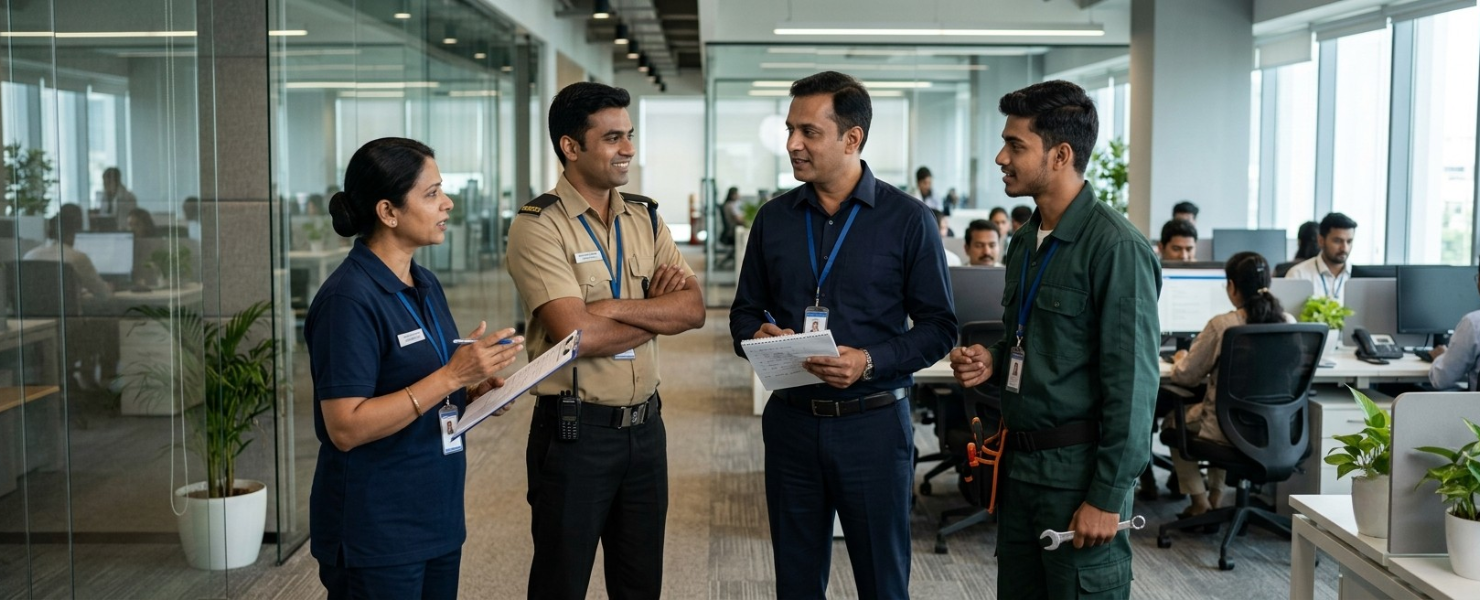
Every successful workplace depends on people whose work often happens quietly in the background. From security personnel welcoming employees at the entrance to housekeeping teams maintaining hygiene, technicians keeping essential systems running, pantry staff supporting daily routines, and supervisors coordinating multiple operations, every role contributes to the smooth functioning of a workplace.
This is where the idea of dignity of labour in facility management becomes especially relevant. Facility management is not simply about maintaining a building. It is about creating a safe, clean, functional and comfortable environment where people can focus on their core responsibilities. Behind that environment is a diverse team of people performing different jobs, each with its own responsibilities and importance.
Mahatma Gandhi’s philosophy placed considerable importance on self-reliance, constructive work and the value of contributing to society. His Constructive Programme: Its Meaning and Place, published in 1948, is part of his documented body of work on building society through constructive activity. While modern facility management is very different from the social context of Gandhi’s time, the broader principle of respecting meaningful work can still offer a useful perspective for today’s workplaces.
Understanding Dignity of Labour in Facility Management
The dignity of labour in facility management begins with recognising that no job should be considered insignificant simply because it happens behind the scenes.
A modern office may look effortless when everything works properly. The floors are clean, washrooms are maintained, air-conditioning systems operate efficiently, security checks happen smoothly and common areas remain organised. But this level of consistency requires people to plan, monitor, clean, repair, coordinate and respond every day.
Facility management brings together several different functions. Industry definitions commonly include areas such as building maintenance, security, health, workplace environment and operational support. This means facility management teams are directly connected to the everyday experience of employees, visitors, customers and business leaders.
When organisations recognise this contribution, the workplace becomes more respectful and collaborative. Employees are more likely to understand that maintaining a workplace is a shared responsibility, even when different people have different roles.
Every Role Contributes to the Workplace Experience
Consider a typical working day. An employee enters an office and is greeted by security. The reception and common areas are clean. The washrooms are maintained. Technical systems are checked. Pantry services are available. Waste is managed properly. If an electrical or plumbing issue occurs, a technician responds.
Most employees may only notice these services when something goes wrong. When everything works as expected, the work behind it can become almost invisible.
That is precisely why recognising every role matters.
A housekeeping professional does more than clean a floor. Their work contributes to hygiene and workplace comfort. A security professional does more than stand at an entrance. Their responsibilities can include access control, visitor management and maintaining a secure environment. A technician does more than repair equipment. Their work helps prevent operational disruptions and supports the functioning of essential building systems.
Facility management therefore depends on teamwork rather than one individual function.

Why Respect Matters in Facility Management Teams
Respect is not simply about using polite language. It is also reflected in how organisations communicate, train, manage and recognise their people.
A facility management team may include individuals with different levels of experience, technical knowledge and responsibilities. When every team member is treated with professionalism, it creates a healthier working environment.
For example, a supervisor who listens to housekeeping staff may identify recurring maintenance or hygiene issues that would otherwise go unnoticed. A security professional who feels comfortable communicating concerns can help management respond to potential risks earlier. A technician who is encouraged to share observations may identify a maintenance requirement before it becomes a larger operational problem.
Respect can therefore support communication and operational consistency at the same time.
The connection between people and facility performance is also recognised within the facility management profession. Recent IFMA material highlights that workplace efficiency depends not only on speed but also on consistency, reliability, coordination and the ability of teams to deliver services without disruption.
Gandhi’s Ideas and the Modern Workplace
Gandhi’s ideas are often discussed in the context of simplicity, self-reliance, service and constructive action. His Constructive Programme remains part of the documented collection of his writings maintained by the Gandhi Heritage Portal.
Applying these ideas to a modern facility management environment does not mean directly equating historical social programmes with today’s professional services. Instead, they can encourage organisations to reflect on a simple question: Do we value the contribution of every person who helps keep our workplace functioning?
This question is particularly important because workplace hierarchies can sometimes make certain roles more visible than others.
A senior executive may make strategic decisions, while a technician ensures that the infrastructure supporting those decisions continues to function. A business leader may focus on customers and growth, while a security professional helps maintain a safe environment for employees and visitors. Both forms of contribution are different, but both support the organisation.
Dignity of Labour Creates a Culture of Mutual Respect
A workplace culture is shaped by everyday behaviour.
When employees greet security guards respectfully, communicate properly with housekeeping teams, cooperate with facility staff and acknowledge technicians for their work, these small actions can influence the overall atmosphere.
The same principle should apply from management to frontline teams. Respect should not depend on job title, salary level or organisational position.
Facility management companies have an important role to play here because their teams often work directly inside client workplaces. Their professionals represent the service provider while interacting daily with the client’s employees, visitors and leadership.
For this reason, professionalism should work in both directions. Facility teams should deliver their responsibilities with discipline and care, while client organisations should create an environment where these teams are treated with dignity.
Training Is Also a Form of Respect
One practical way of demonstrating respect for facility management professionals is investing in their development.
Training helps employees understand not only what they need to do but also why their work matters. Security personnel may require training in access control, emergency response and visitor handling. Housekeeping teams may need guidance on hygiene procedures, equipment and workplace protocols. Technical teams require knowledge of building systems, preventive maintenance and safety practices.
Training also improves consistency.
IFMA describes facility management as a field involving people, processes and technology working together to support efficient and functional facilities. This makes workforce capability an important part of service delivery.
A trained professional is better equipped to handle responsibilities confidently. At the same time, providing training communicates that the organisation sees the individual as an important part of its operation rather than simply as manpower.
The Role of Leadership in Respecting Every Role
Leadership sets the tone for how different roles are treated.
If leaders communicate respectfully with facility teams, recognise their contributions and involve them in relevant conversations, other employees are more likely to follow the same behaviour.
Leadership can also encourage practical collaboration. For instance, facility supervisors can regularly communicate with administration and HR teams about recurring workplace concerns. Employees can be encouraged to report maintenance or housekeeping issues respectfully instead of blaming individuals.
The goal is not to create a culture where every issue is ignored in the name of respect. Accountability remains important. Rather, concerns should be addressed professionally, with a focus on improving processes and resolving problems.

Facility Management Is About People as Much as Places
Buildings are made of concrete, glass, steel, electrical systems, plumbing networks, furniture and technology. But a functioning workplace depends on people managing all these elements.
This is why facility management is ultimately a people-centred service.
From preventive maintenance and housekeeping to security, pantry services, technical support and workplace coordination, different teams contribute to the daily experience of an organisation. IFMA’s recent facility management coverage similarly describes teams working across maintenance, cleaning, waste management, utilities and operational support as essential to keeping facilities functioning effectively.
At Sonip Global Facility Management, this perspective can be reflected through an integrated approach to security and facility management, where different service functions work together to support client workplaces.
Whether the requirement involves housekeeping, technical maintenance, security, pest control, pantry and F&B support, CCTV monitoring, deep cleaning or other workplace services, the quality of the final experience depends on the people delivering those services.
Building Better Workplaces Through Respect
A well-managed workplace is not only one where everything looks clean and systems work properly. It is also a workplace where the people responsible for maintaining that environment are respected.
The idea of dignity of labour in facility management encourages businesses to look beyond job titles and recognise contribution. It reminds organisations that every role has a purpose and that operational excellence is often created through hundreds of small tasks performed consistently every day.
This approach can also strengthen teamwork. When people feel their contribution is recognised, communication can become more open. When communication improves, operational issues can be identified earlier. When teams coordinate better, workplace services can become more consistent.
The result is a workplace where professionalism is not limited to senior management or customer-facing roles. It becomes part of the entire facility ecosystem.
How Businesses Can Promote Dignity of Labour
Businesses can build a more respectful facility management culture through everyday practices rather than complicated policies.
Some practical approaches include:
- Treating every facility professional with courtesy and respect.
- Providing role-specific training and safety guidance.
- Creating clear channels for reporting workplace concerns.
- Recognising consistent performance across different functions.
- Encouraging employees and facility teams to communicate professionally.
- Including facility teams in relevant workplace safety and operational discussions.
These steps may appear simple, but consistent implementation can help create a more collaborative workplace.
From Service Providers to Workplace Partners
The relationship between a business and its facility management provider can be more effective when it is viewed as a partnership rather than simply a vendor arrangement.
A facility management partner understands the workplace environment, coordinates teams and helps maintain service standards. The client organisation, meanwhile, provides the context, expectations and operational requirements necessary for the team to deliver effectively.
At Sonip Global Facility Management, an integrated service approach can help businesses coordinate multiple workplace requirements through one facility management partner. This can include security, housekeeping, technical maintenance, pest control, pantry and F&B services, CCTV, deep cleaning, facade cleaning and other operational support.
The larger objective is simple: create workplaces where people can focus on their core business while essential facility functions are managed professionally.
Conclusion: Respect Every Role, Strengthen Every Workplace
Gandhi’s ideas continue to encourage conversations about service, responsibility, self-reliance and meaningful contribution. His Constructive Programme provides one historical reference point for understanding his broader approach to constructive social action.
In today’s business environment, the dignity of labour in facility management can be understood through a practical workplace principle: every person who contributes to a safe, clean, secure and functional workplace deserves professional respect.
A security officer, housekeeping professional, technician, supervisor, pantry associate or facility manager may perform very different tasks. Yet together, their work creates the environment in which businesses operate every day.
Respecting every role is therefore not only about recognising people. It is about recognising how workplaces actually function.
When businesses value the people behind their facilities, they can build a culture based on cooperation, professionalism and shared responsibility. And when every role is treated with dignity, the workplace becomes more than a well-maintained building. It becomes a more respectful environment for everyone.
Frequently Asked Questions
1. What does dignity of labour mean in facility management?
Dignity of labour in facility management means recognising and respecting the contribution of every professional involved in maintaining a workplace. This includes security personnel, housekeeping teams, technicians, supervisors, pantry staff and facility managers.
2. Why is dignity of labour important in facility management?
Facility management depends on many different people working together. Respecting every role can support better communication, teamwork and professional collaboration while recognising the importance of behind-the-scenes work.
3. What roles are included in facility management?
Facility management can include security, housekeeping, technical maintenance, pest control, pantry and F&B services, cleaning, waste management, CCTV monitoring, utilities management and other workplace support functions.
4. How can companies show respect to facility management teams?
Companies can show respect by communicating professionally, providing appropriate training, recognising good performance, maintaining safe working conditions and treating facility professionals as an important part of the workplace ecosystem.
5. How does Gandhi’s philosophy relate to dignity of labour?
Gandhi’s broader philosophy included ideas around self-reliance, constructive work and service. His Constructive Programme: Its Meaning and Place documents his approach to constructive social action. These ideas can provide a historical perspective for modern discussions about valuing meaningful work.
6. Can dignity of labour improve workplace culture?
Respect for different roles can contribute to a more collaborative workplace culture. When people communicate respectfully and understand each other’s responsibilities, teams may find it easier to coordinate daily operations and address workplace issues.
7. Why should businesses work with an integrated facility management provider?
An integrated facility management provider can help coordinate multiple workplace services through a single partner. This can simplify communication, support consistent service delivery and allow businesses to focus more on their core activities.
8. What facility management services does Sonip Global provide?
Sonip Global Facility Management provides integrated workplace support across areas such as security, housekeeping, technical maintenance, pest control, pantry and F&B services, CCTV, deep cleaning, facade cleaning and related facility management requirements.
9. How can facility management teams support business productivity?
Facility management teams help maintain the physical environment in which employees work. By supporting cleanliness, security, maintenance, comfort and day-to-day operations, they help create an environment where businesses can focus on their primary activities.
